← Back to Bar Graph Hub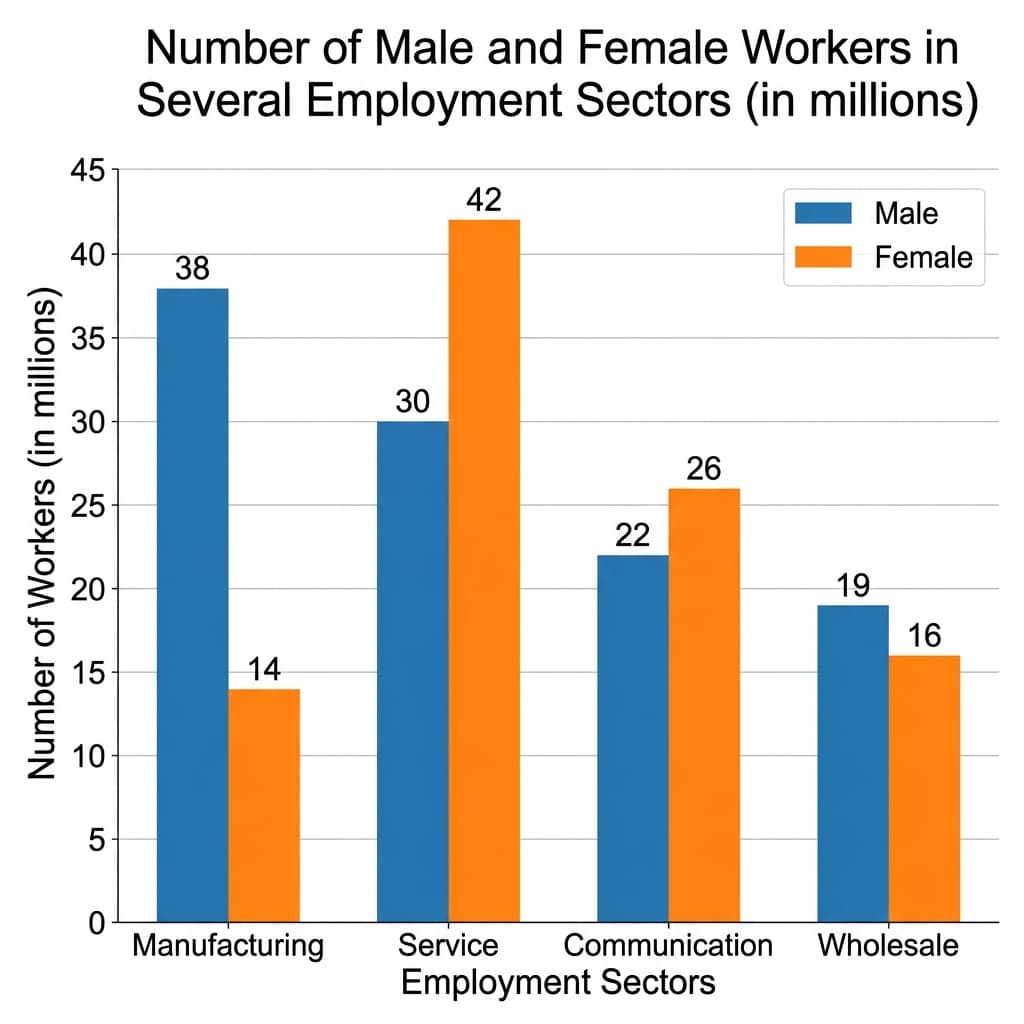
Male and female workers in several employment sectors
The Question:
The bar chart below shows the number of male and female workers in 1975 and 1995 in several employment sectors in a specific country.
✍️ Band 9 Model Answer
The bar chart compares the distribution of male and female employees across four distinct job sectors in the years 1975 and 1995.
Overall, there was a pronounced shift towards higher female participation in most industries over the twenty-year period. While the manufacturing sector remained male-dominated, the service and communication sectors saw a significant narrowing of the gender gap.
In 1975, the manufacturing industry was overwhelmingly male, with 600,000 men compared to only 150,000 women. By 1995, while male numbers stayed relatively stable, the female workforce in this sector had grown to 250,000. In sharp contrast, the service sector saw explosive growth for both genders. Female workers in services jumped from 400,000 in 1975 to a staggering 800,000 in 1995, actually overtaking the number of male workers, which stood at 700,000 in the same year.
The communication sector also reflected this trend of equalization. From a base of 200,000 males and 100,000 females in 1975, the numbers converged significantly by 1995, reached roughly 350,000 for both genders. Meanwhile, the wholesale and retail sector maintained a consistent presence for both groups, although female participation increased from 250,000 to nearly 500,000 by the end of the period, demonstrating a clear trend towards a more balanced workforce across the board.
✨ Key Vocabulary & Phrasing
PronouncedVery noticeable or marked; conspicuous.
Narrowing of the gapThe reduction in difference between two things.
Explosive growthExtremely rapid and large-scale increase.
ConvergedCame together from different directions so as eventually to meet.
EqualizationThe act of making things equal.
Practice this task with AI
Write your own response to this prompt and get an instant Band 9 evaluation with detailed feedback.
Start Writing EvaluatorExpert Insights
Frequently Asked Questions
Get definitive answers from IELTS examiners and high-band experts.
You should spend exactly 20 minutes on Task 1. This leaves you with 40 minutes for the more heavily weighted Task 2.
You must write at least 150 words. Writing significantly less will result in a penalty for your Task Achievement score.
No. Task 1 (Academic) is an objective summary of data. You should never include personal opinions or external information not shown in the chart.
Standard structure: Introduction (paraphrase), Overview (state main trends), and 2-3 Detail paragraphs (describe specific data points).
The most common types are Bar Graphs, Line Graphs, Pie Charts, Tables, Process Diagrams, and Maps.
Yes. Without a clear overview highlighting the main features or trends, it is impossible to score Band 7 or higher in Task Achievement.
It is generally better to use formal, passive voice and avoid personal pronouns like 'I' or 'me'.
Varying your language with phrases like 'a significant majority' or 'roughly a quarter' demonstrates a higher lexical resource for Band 7+.