← Back to Bar Graph Hub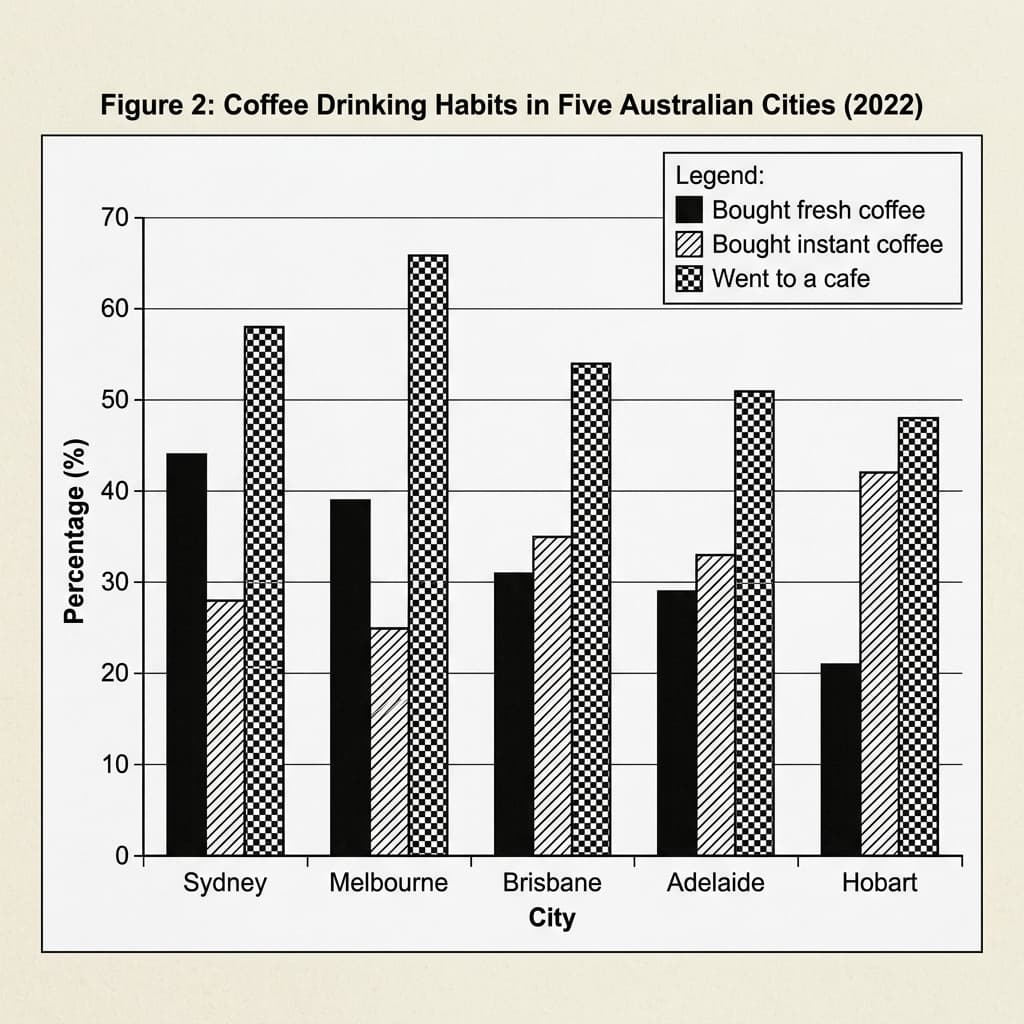
Coffee and Tea consumption in five Australian cities
The Question:
The bar chart below shows the percentage of people in five Australian cities who purchased fresh coffee or tea in the last 4 weeks.
✍️ Band 9 Model Answer
The bar chart illustrates the proportions of residents in Sydney, Melbourne, Brisbane, Adelaide, and Hobart who engaged in three different coffee and tea-related habits over a four-week period.
Overall, it is immediately apparent that "going to a cafe for coffee or tea" was the most popular activity across all cities, with the exception of Adelaide. Conversely, purchasing fresh coffee was consistently the least common behavior in the majority of the locations surveyed.
Regarding social consumption, Melbourne emerged as the leader, with nearly 64% of its citizens visiting cafes. Hobart and Sydney followed closely behind, both hovering around the 61-62% mark. Brisbane saw approximately 56% participation, while Adelaide recorded the lowest figure in this category at just under 50%.
In terms of home consumption, the patterns were quite distinct. Buying instant coffee was particularly prevalent in Hobart, where it peaked at 54%, surpassing cafe visits in that city. In contrast, fresh coffee purchases were noticeably lower across the board. Sydney and Melbourne showed the highest interest in fresh coffee at roughly 43%-44%, whereas in Brisbane, Adelaide, and Hobart, only about 34% to 38% of residents opted for fresh beans or grounds. Notably, in Adelaide, instant coffee (50%) was significantly more popular than both fresh coffee (34%) and cafe visits (49%).
✨ Key Vocabulary & Phrasing
ProportionsPercentages or fractions of a whole.
Hovering aroundStaying close to a specific number.
PrevalentCommon or widespread in a particular area.
Across the boardApplying to all individuals or categories.
Opted forChose a specific option.
Practice this task with AI
Write your own response to this prompt and get an instant Band 9 evaluation with detailed feedback.
Start Writing EvaluatorExpert Insights
Frequently Asked Questions
Get definitive answers from IELTS examiners and high-band experts.
You should spend exactly 20 minutes on Task 1. This leaves you with 40 minutes for the more heavily weighted Task 2.
You must write at least 150 words. Writing significantly less will result in a penalty for your Task Achievement score.
No. Task 1 (Academic) is an objective summary of data. You should never include personal opinions or external information not shown in the chart.
Standard structure: Introduction (paraphrase), Overview (state main trends), and 2-3 Detail paragraphs (describe specific data points).
The most common types are Bar Graphs, Line Graphs, Pie Charts, Tables, Process Diagrams, and Maps.
Yes. Without a clear overview highlighting the main features or trends, it is impossible to score Band 7 or higher in Task Achievement.
It is generally better to use formal, passive voice and avoid personal pronouns like 'I' or 'me'.
Varying your language with phrases like 'a significant majority' or 'roughly a quarter' demonstrates a higher lexical resource for Band 7+.