← Back to Table Hub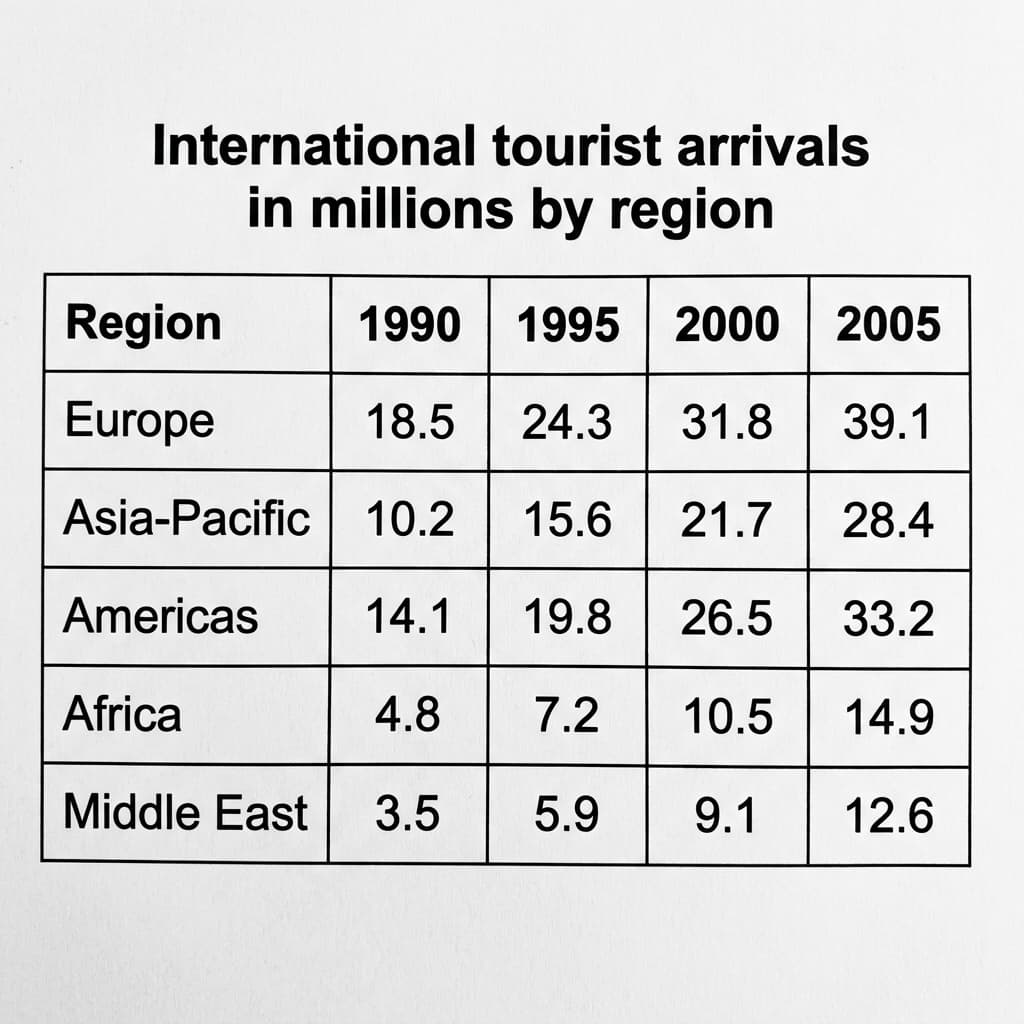
International tourist arrivals in millions by region
The Question:
The table below shows the number of international tourist arrivals in five different regions in 1990, 1995, 2000 and 2005.
✍️ Band 9 Model Answer
The table illustrates the global trends in international tourism by tracking the number of arrivals in millions across five distinct geographic regions from 1990 to 2005.
Overall, the data reveals a universal increase in international travel over the fifteen-year period. Europe consistently attracted the highest volume of tourists, while the Middle East and Africa, despite seeing significant growth, remained the least visited regions.
Europe maintained its clear dominance throughout the period. Starting at 280 million arrivals in 1990, it saw a steady climb to reach 400 million by 2005. Asia and the Pacific experienced the most notable surge in popularity; the number of tourists in this region more than doubled, jumping from 60 million in 1990 to an impressive 135 million by the end of the timeframe.
The Americas also followed an upward trajectory, though with a slight plateau between 2000 and 2005. Arrivals rose from 90 million in 1990 to 118 million in 2000, before settling at 113 million in 2005. Meanwhile, Africa and the Middle East started from much lower bases. International visitors to Africa rose from 18 million to 40 million, while the Middle East saw its numbers climb from 9.8 million to 13 million over the same period, representing nearly a fourfold increase for the former.
✨ Key Vocabulary & Phrasing
UniversalRelating to or done by all people or things in the world.
VolumeThe amount or quantity of something.
PlateauA state of little or no change following a period of activity or progress.
BasesThe starting points for a measurement or calculation.
FourfoldFour times as great or as many.
Practice this task with AI
Write your own response to this prompt and get an instant Band 9 evaluation with detailed feedback.
Start Writing EvaluatorExpert Insights
Frequently Asked Questions
Get definitive answers from IELTS examiners and high-band experts.
You should spend exactly 20 minutes on Task 1. This leaves you with 40 minutes for the more heavily weighted Task 2.
You must write at least 150 words. Writing significantly less will result in a penalty for your Task Achievement score.
No. Task 1 (Academic) is an objective summary of data. You should never include personal opinions or external information not shown in the chart.
Standard structure: Introduction (paraphrase), Overview (state main trends), and 2-3 Detail paragraphs (describe specific data points).
The most common types are Bar Graphs, Line Graphs, Pie Charts, Tables, Process Diagrams, and Maps.
Yes. Without a clear overview highlighting the main features or trends, it is impossible to score Band 7 or higher in Task Achievement.
It is generally better to use formal, passive voice and avoid personal pronouns like 'I' or 'me'.
Varying your language with phrases like 'a significant majority' or 'roughly a quarter' demonstrates a higher lexical resource for Band 7+.