← Back to Process Diagram Hub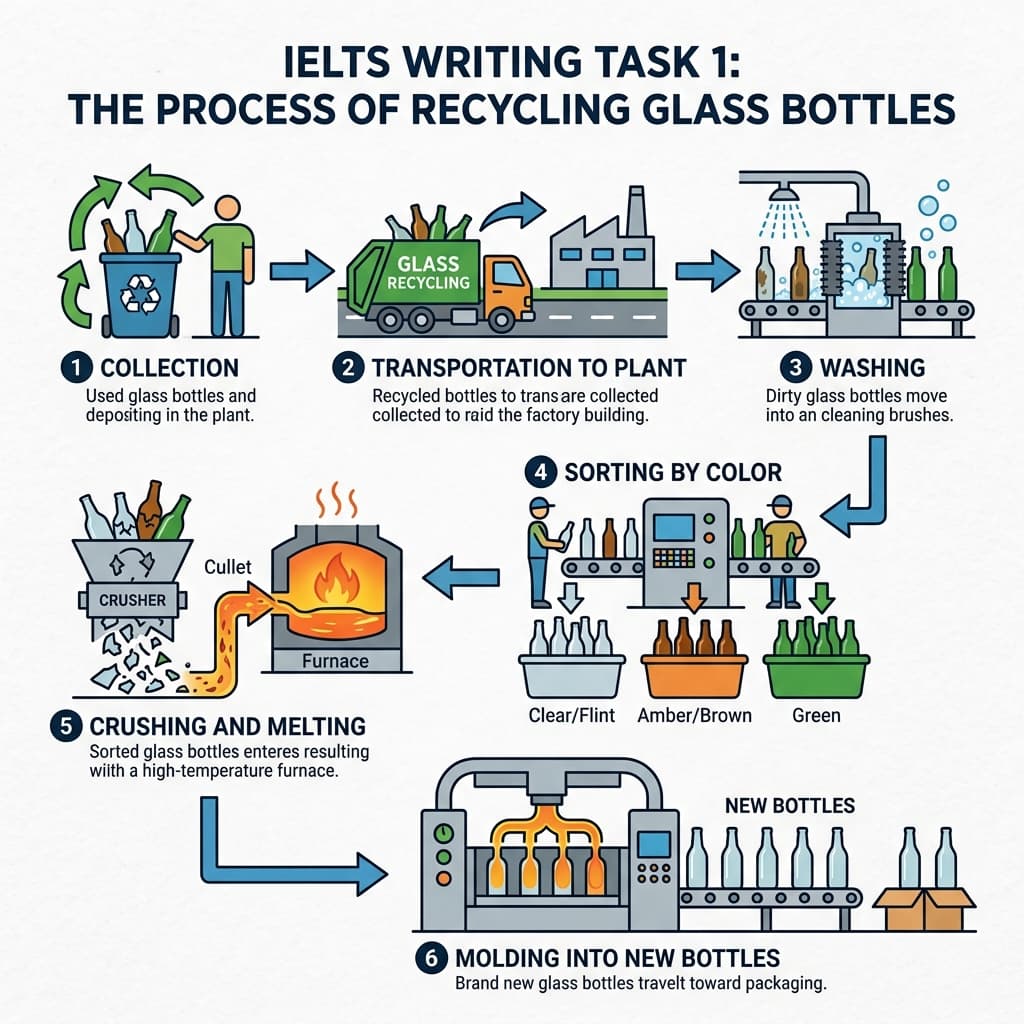
The process of recycling glass bottles
The Question:
The diagram below shows the process of how glass bottles are recycled.
✍️ Band 9 Model Answer
The flow diagram outlines the various stages involved in the cycle of recycling glass bottles, from initial disposal to the creation of new products.
Overall, the process is a closed-loop system consisting of three main phases: collection and transportation, processing at a specialized facility, and finally, manufacturing and consumption.
The cycle begins with consumers depositing glass bottles and jars into designated recycling bins. These containers are then collected by specialized trucks and transported to a glass treatment plant. Once at the facility, the glass is thoroughly washed using high-pressure water to remove labels and any lingering contaminants.
Following the cleaning phase, the glass is sorted by color (typically clear, green, and brown) and then crushed into small fragments known as cullet. This cullet is then fed into a high-temperature furnace where it is melted down into a molten liquid state. At this stage, a small amount of new raw materials may be added to the mixture. The molten glass is then shaped into new bottles and jars using molds. Finally, these recycled products are filled with liquids, such as beverages, and distributed to retail outlets, thus completing the cycle as they return to the consumer.
✨ Key Vocabulary & Phrasing
DesignatedAppointed or set aside for a specific purpose.
ContaminantsSubstances that make something impure or unsuitable for use.
FragmentsSmall parts broken off or detached from something.
MoltenMaterials (especially metal or glass) liquefied by heat.
Retail outletsStores where goods are sold directly to the public.
Practice this task with AI
Write your own response to this prompt and get an instant Band 9 evaluation with detailed feedback.
Start Writing EvaluatorExpert Insights
Frequently Asked Questions
Get definitive answers from IELTS examiners and high-band experts.
You should spend exactly 20 minutes on Task 1. This leaves you with 40 minutes for the more heavily weighted Task 2.
You must write at least 150 words. Writing significantly less will result in a penalty for your Task Achievement score.
No. Task 1 (Academic) is an objective summary of data. You should never include personal opinions or external information not shown in the chart.
Standard structure: Introduction (paraphrase), Overview (state main trends), and 2-3 Detail paragraphs (describe specific data points).
The most common types are Bar Graphs, Line Graphs, Pie Charts, Tables, Process Diagrams, and Maps.
Yes. Without a clear overview highlighting the main features or trends, it is impossible to score Band 7 or higher in Task Achievement.
It is generally better to use formal, passive voice and avoid personal pronouns like 'I' or 'me'.
Varying your language with phrases like 'a significant majority' or 'roughly a quarter' demonstrates a higher lexical resource for Band 7+.