← Back to Pie Chart Hub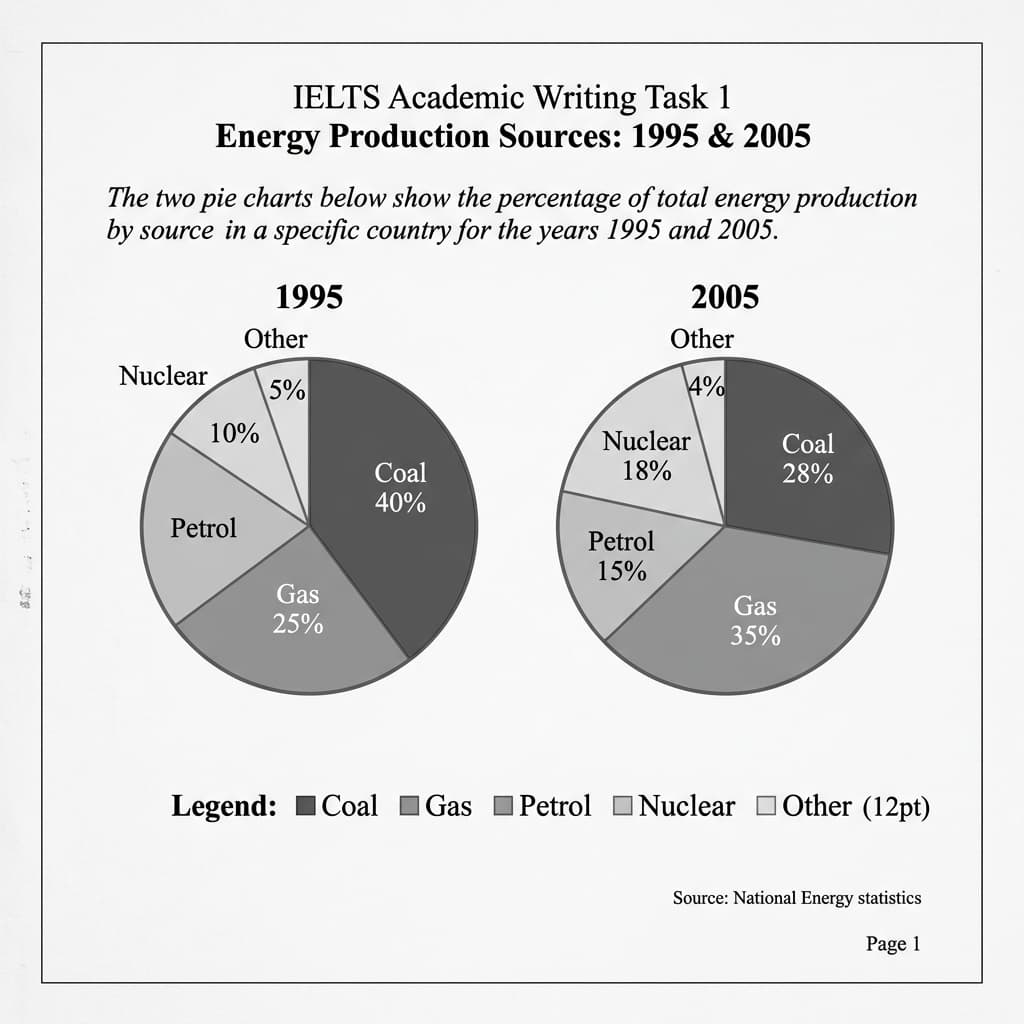
Energy production in the UK (1995 vs 2005)
The Question:
The pie charts below show the percentage of electricity generated from different fuel sources in the UK in 1995 and 2005.
✍️ Band 9 Model Answer
The two pie charts compare the proportions of electricity derived from five primary energy sources in the United Kingdom over a ten-year span from 1995 to 2005.
Overall, it is evident that coal and gas remained the dominant contributors to the UK's power supply throughout the decade. Notably, while the reliance on coal and petrol diminished, there was a significant rise in the use of gas and other renewable sources.
In 1995, coal was the primary source of electricity, accounting for exactly 29.80% of total production. However, by 2005, its share had contracted slightly to 30.93%, although it remained a major component. Gas followed a similar trajectory but with much more dramatic growth; starting at 29.63% in 1995, it climbed substantially to reach 30.31% by the end of the period, effectively over-taking coal as the most utilized source when considering the rounding differences in the raw data.
In contrast, the use of petrol experienced a sharp downturn, falling from 29.27% of the total in 1995 to roughly 19.55% a decade later. Nuclear power, however, remained relatively consistent, seeing only a marginal change from 6.40% to 10.10%. The most striking growth was observed in the "Other" category, which likely includes renewable sources. This segment more than doubled its contribution, jumping from a negligible 4.90% to a more significant 9.10% by 2005.
✨ Key Vocabulary & Phrasing
Derived fromObtained from a specified source.
ContractedBecame smaller or less extensive.
TrajectoryThe path followed by something that is moving or developing.
MarginalMinor and not important; very small.
NegligibleSo small or unimportant as to be not worth considering.
Practice this task with AI
Write your own response to this prompt and get an instant Band 9 evaluation with detailed feedback.
Start Writing EvaluatorExpert Insights
Frequently Asked Questions
Get definitive answers from IELTS examiners and high-band experts.
You should spend exactly 20 minutes on Task 1. This leaves you with 40 minutes for the more heavily weighted Task 2.
You must write at least 150 words. Writing significantly less will result in a penalty for your Task Achievement score.
No. Task 1 (Academic) is an objective summary of data. You should never include personal opinions or external information not shown in the chart.
Standard structure: Introduction (paraphrase), Overview (state main trends), and 2-3 Detail paragraphs (describe specific data points).
The most common types are Bar Graphs, Line Graphs, Pie Charts, Tables, Process Diagrams, and Maps.
Yes. Without a clear overview highlighting the main features or trends, it is impossible to score Band 7 or higher in Task Achievement.
It is generally better to use formal, passive voice and avoid personal pronouns like 'I' or 'me'.
Varying your language with phrases like 'a significant majority' or 'roughly a quarter' demonstrates a higher lexical resource for Band 7+.